


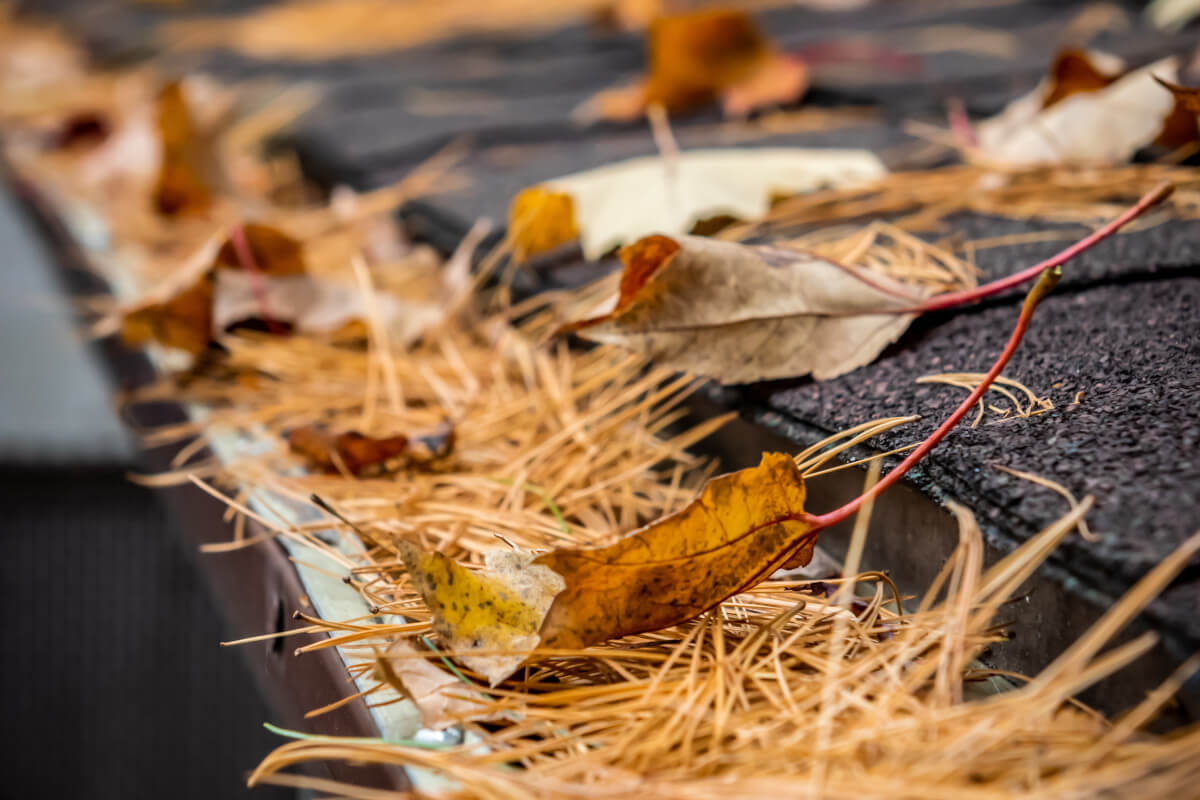
Pine needles defeat almost every gutter guard on the market. There’s exactly one type that reliably stops them. Here’s why most guards fail against pine, what actually works, and what we install for the metro Atlanta homeowners dealing with this every year.
If you have pine trees near your house, you already know the problem. You’ve probably tried a guard system that the contractor swore would handle pine needles — and then the next fall, you watched pine straw build up on top of it, dam against it, or slip right through it into your gutter anyway.
You’re not crazy and you didn’t get unlucky. The vast majority of gutter guards on the market genuinely cannot handle pine needles. This page covers exactly why, and what actually solves the problem.
Get a Free Pine Needle Guard Estimate — 770-369-3743
Why Pine Needles Defeat Most Gutter Guards
A pine needle is a very specific kind of debris. It’s roughly 3 to 6 inches long depending on the species (longleaf pines have the longest), but it’s incredibly thin — typically less than a millimeter in diameter at its widest point. That thinness is what causes the problem.
Screen guards fail because the openings — even on “fine” mesh screens — are wider than a pine needle is thick. The needles thread through the openings and drop into the gutter. We’ve pulled out gallons of pine straw from gutters with brand-new screen guards on top.
Perforated metal guards fail for the same reason. The holes, designed to pass water while stopping leaves, are dramatically larger than a pine needle’s cross-section.
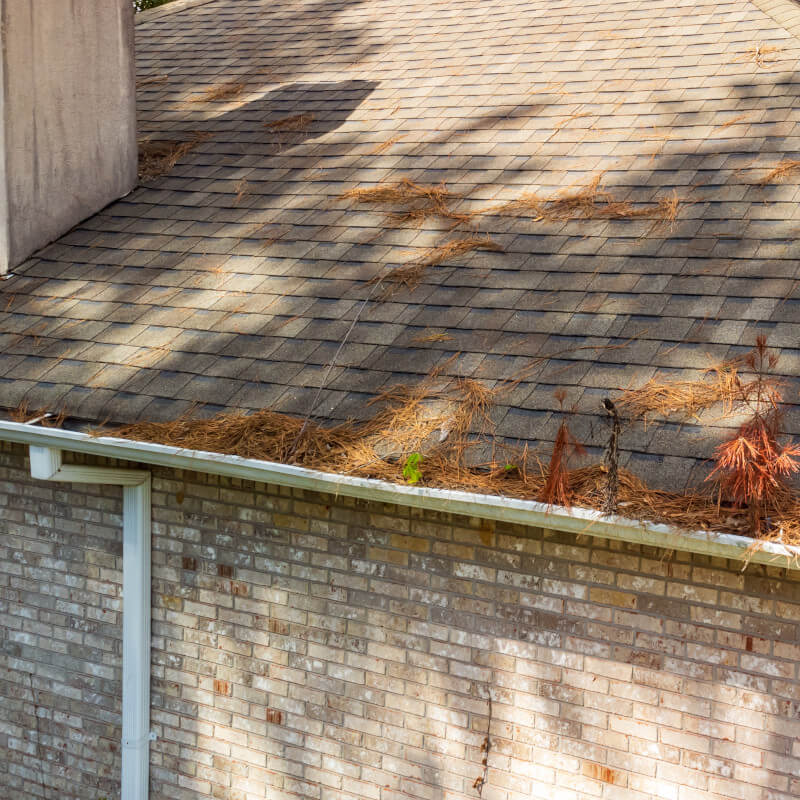
Reverse curve guards fail in a different way. The pine needles don’t pass through — they catch in the front slot, where the water enters. Over a couple of seasons, you get a mat of pine straw welded across the front opening, and the gutter stops receiving water. We’ve removed reverse curve systems on metro Atlanta homes that had become essentially decorative — water sheeting off the front edge of the cover because the intake slot was completely dammed.
Foam guards fail because pine needles work their way down into the foam pores and stay there. The foam becomes saturated, supports microbial growth, and turns into a sponge that holds water in the gutter rather than letting it pass through.
Brush guards fail by trapping pine needles in the bristles. Removing the embedded needles requires pulling the brushes, cleaning them, and reinstalling them — more work than just cleaning a bare gutter would have been.
We’ve removed all five of these guard types from metro Atlanta homes where pine cover was the unaddressed problem. Each one fails differently, but they all fail.
Call 770-369-3743 or use our Contact Form to schedule a FREE QUOTE today!
What Actually Works: Micro Mesh
Micro mesh is the only type of gutter guard whose mesh openings are smaller than the diameter of a pine needle. Over the years we’ve compared all guard types and micro mesh continues to come out on time regarding pine needle problems
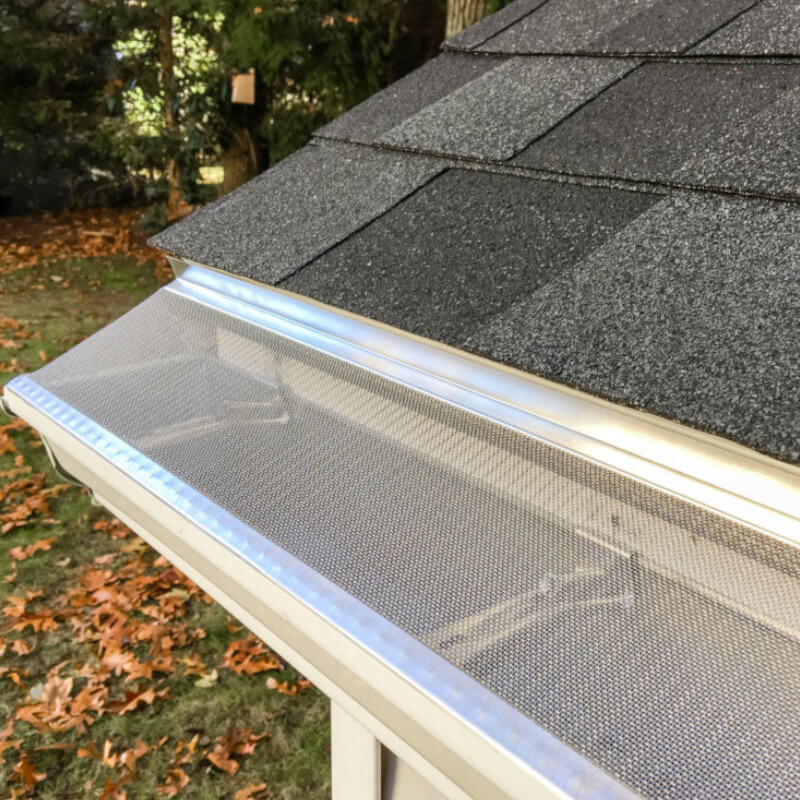
Quality micro mesh systems use stainless steel mesh with openings between roughly 50 and 200 microns — far smaller than the cross-section of any pine needle. The needles land on top of the mesh, dry out in the sun, and either blow off in wind or wash off in rain. They cannot physically pass through.
This isn’t a marketing claim. It’s a function of the mesh dimension being smaller than the debris dimension. Any guard type with openings, slots, or gaps larger than the diameter of a pine needle will allow pine needles to pass through. Any guard type with openings smaller than that will not.
For more on micro mesh specifically — what we install, what to look for, what to avoid — see our micro mesh gutter guards page.
Why Metro Atlanta Has This Problem Worse Than Most Places
Metro Atlanta sits inside the natural range of multiple pine species. Most established neighborhoods have substantial pine cover, often a mix:
Loblolly pines — the dominant pine across most of the region. Needles 6–9 inches long, dropped continuously throughout the year with a heavy peak in late fall.
Shortleaf and Virginia pines — common in the northern suburbs. Shorter needles (3–5 inches) but heavier seasonal drops.
Longleaf pines — less common in the immediate metro area but present in some neighborhoods, especially in north Cherokee and Cobb. The longest needles of any species — up to 18 inches — which behave differently than shorter pine straw.
White pines — used heavily as ornamentals in older neighborhoods. Soft, flexible needles that wedge into gutter screens easily.
Most homes in the Marietta–Woodstock–Roswell corridor have at least one of these species directly overhead, and many have several. The result is a year-round pine straw drop that’s heavier and more sustained than what most national gutter guard products were designed for.
The cherry on top: the same wind events that drop pine needles also drop oak debris, sweet gum balls, and hardwood leaves. A guard system in our region has to handle pine plus everything else — not pine alone.
Call 770-369-3743 or use our Contact Form to schedule a FREE QUOTE today!
What We Install for Pine Problems
We install professional-grade stainless steel micro mesh systems with mesh fine enough to stop pine needles and frame construction designed to handle real-world conditions in our climate. Specifically:
- 304 or 316 stainless steel mesh — won’t rust, won’t corrode from contact with debris
- Mesh openings between 100 and 200 microns — fine enough to stop pine needles, coarse enough to not clog with pollen
- Aluminum frames with proper expansion tolerances
- Low-profile attachment to the gutter front and rear lip — doesn’t lift roof shingles, doesn’t void roof warranties
- Installed at a slight pitch matching the roof — so pine straw and other debris naturally sheds off the front edge rather than sitting flat on the mesh
We carry several systems and recommend based on what’s actually overhead at your home, the angle of your roofline, and the condition of your existing gutters. Different homes need different specific products. We’ll show you what fits yours.
Pre-Install: Cleaning Out Existing Pine Straw
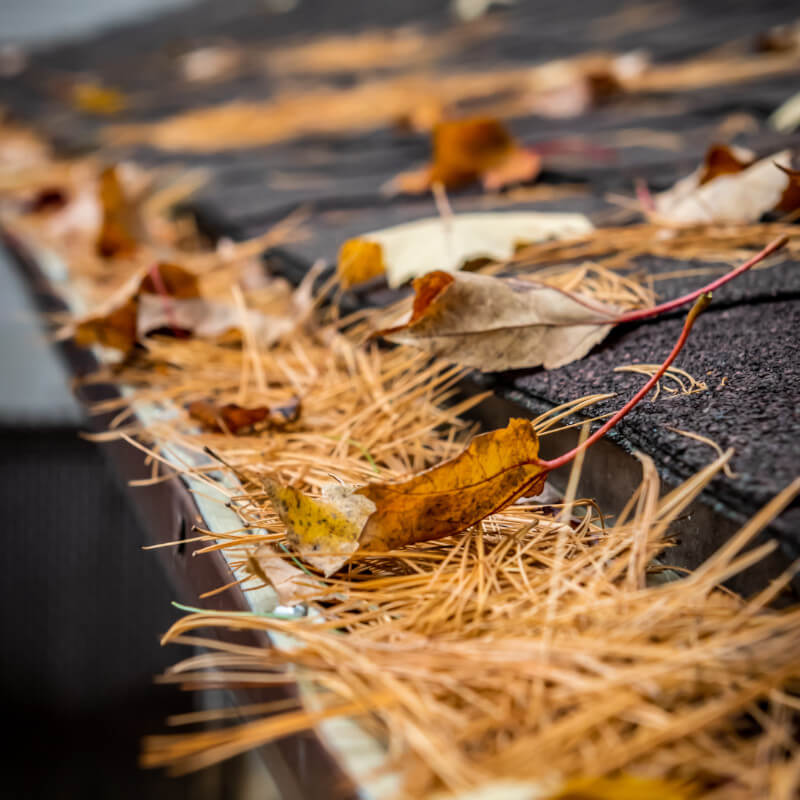
If you’ve been living with pine straw in your gutters for any length of time, the gutters underneath are almost certainly packed with old debris. We don’t install guards on uncleaned gutters — installing over old pine straw makes the problem permanent.
Every pine-needle-focused install starts with a thorough gutter cleaning: hand removal of all pine straw and accumulated debris, a full water test of every downspout, and a check for any drainage issues hiding under the pine layer.
If we find existing damage (rotted fascia under the gutters, seam leaks that have been hidden by debris, sagging from years of wet weight), we’ll show you what we find and quote the necessary repair work separately before any guards go on.
This is the step that distinguishes a guard install that works for 20 years from one that fails in two. The pre-install matters as much as the guard itself.
What It Costs
For real pricing, micro mesh installation in metro Atlanta generally runs $7 to $14 per linear foot, depending on the specific system, the height of the home, and the complexity of the install. For a typical single-story home with around 180 linear feet of gutters, most installs land in the $1,400 to $2,800 range.
Most pine-problem homes are an additional pre-install cleaning, typically $200–$400 for a single-story home with manageable access. Two-story homes or homes with heavy long-standing pine accumulation may run higher.
Replacement of damaged gutters (when needed) is a separate line item, quoted before any work proceeds.
Every estimate is written, itemized, and no-obligation. We don’t quote pine needle problems over the phone — every property is different and the right system depends on what we see at the home.
Call 770-369-3743 or use our Contact Form to schedule a FREE QUOTE today!
What You Should Expect After Install
A correctly installed micro mesh system on a pine-heavy property will:
- Stop essentially all pine needles from entering the gutter
- Shed dry pine straw naturally with wind and rain
- Reduce gutter maintenance to an annual rinse and a visual check after major storms
- Last 20–25+ years before any significant service is needed
What it won’t do:
- Eliminate maintenance entirely — pine straw accumulates on top of the mesh between storms; in a heavy drop week, you’ll see straw on the mesh until the next rain or windy day clears it
- Self-clean instantly — there’s a brief lag between when pine needles land and when they clear
- Work indefinitely without a hose rinse — once a year, ideally before the fall heavy drop, the mesh benefits from a wash to clear shingle grit and pollen accumulation that builds up underneath the pine straw
This honesty matters because the “set it and forget it forever” promise some national-brand guard companies make is the source of most homeowner disappointment with the category. A quality micro mesh system reduces maintenance by roughly 90% — not 100%. That 90% reduction is enormously valuable. The marketing claim of 100% reduction is what creates the bad reputation when real-world performance doesn’t match.
Common Questions
Yes — and the reason is mechanical, not promotional. Pine needles are roughly 1 millimeter in diameter at the widest. Quality micro mesh openings are 100–200 microns — five to ten times smaller. Needles physically cannot pass through. If a product calls itself “micro mesh” but the openings are larger than that, it’s mislabeled.
Length doesn’t matter for filtration. The needle’s diameter is what determines whether it can pass through the mesh, and longleaf pine needles are the same diameter as loblolly or white pine needles. They sit on top of the mesh longer because they’re larger, but they clear with wind and rain just like shorter needles.
No. Stainless steel mesh is harder than dried pine straw, and the mesh openings don’t enlarge from contact. The only ways quality micro mesh fails are from physical damage (branches falling on the system) or from frame fastener failure over a 20+ year lifespan.
Pine sap on the mesh is rare — sap is a wound response from the tree, not part of normal needle drop. When it does happen, it can usually be cleared with a hose rinse and a soft brush. We’ve not seen a case of permanent sap damage to a quality micro mesh system.
For most pine-heavy metro Atlanta properties, the math favors micro mesh within 3–4 years. Pine-heavy homes typically need 3–4 gutter cleanings per year ($200–$400 each) to stay ahead of the drop. A $2,000 micro mesh install replaces $600–$1,600 per year of cleaning, every year, for 20+ years. The break-even is usually faster than people expect.
Brief accumulation between rain or wind events is normal and expected. Persistent piles that don’t clear after multiple weather events usually mean one of two things: the mesh wasn’t installed at the proper pitch (it’s flat, so straw doesn’t naturally shed), or there’s a specific spot where wind patterns push straw into a corner and concentrate it. Both are addressable — we come back and adjust.
You can buy micro mesh at home improvement stores, yes. The performance of the system depends heavily on correct pitch, proper attachment, detailing at corners and end caps, and using a quality mesh rather than the budget product carried at retail. DIY installs commonly fail at the install details, even when the materials are decent. For pine-heavy properties especially, we’d recommend professional install — the failure modes from a bad DIY install can cost more to remediate than the original professional install would have been.
Some homeowners genuinely consider this, and we won’t talk you out of it if it makes sense for your property. But mature pine removal is expensive ($1,500–$4,000+ per tree depending on size and access), it can hurt property value in neighborhoods where mature trees are part of the character, and it doesn’t address pine needle drop from neighbors’ trees that may overhang your roof. A micro mesh system handles the pine straw without removing the trees.
Get a Free Pine Needle Gutter Guard Estimate
If pine needles in your gutters are the problem you’re finally tired of dealing with, we’d be glad to come out, look at what’s overhead, evaluate your current system, and put together an honest quote for a real solution. Estimates are free, written, and no-obligation.
At The Life Home Services, we’ll show you the specific micro mesh systems we install — not stock photos.
Call 770-369-3743 or use our Contact Form to schedule a FREE QUOTE today!