


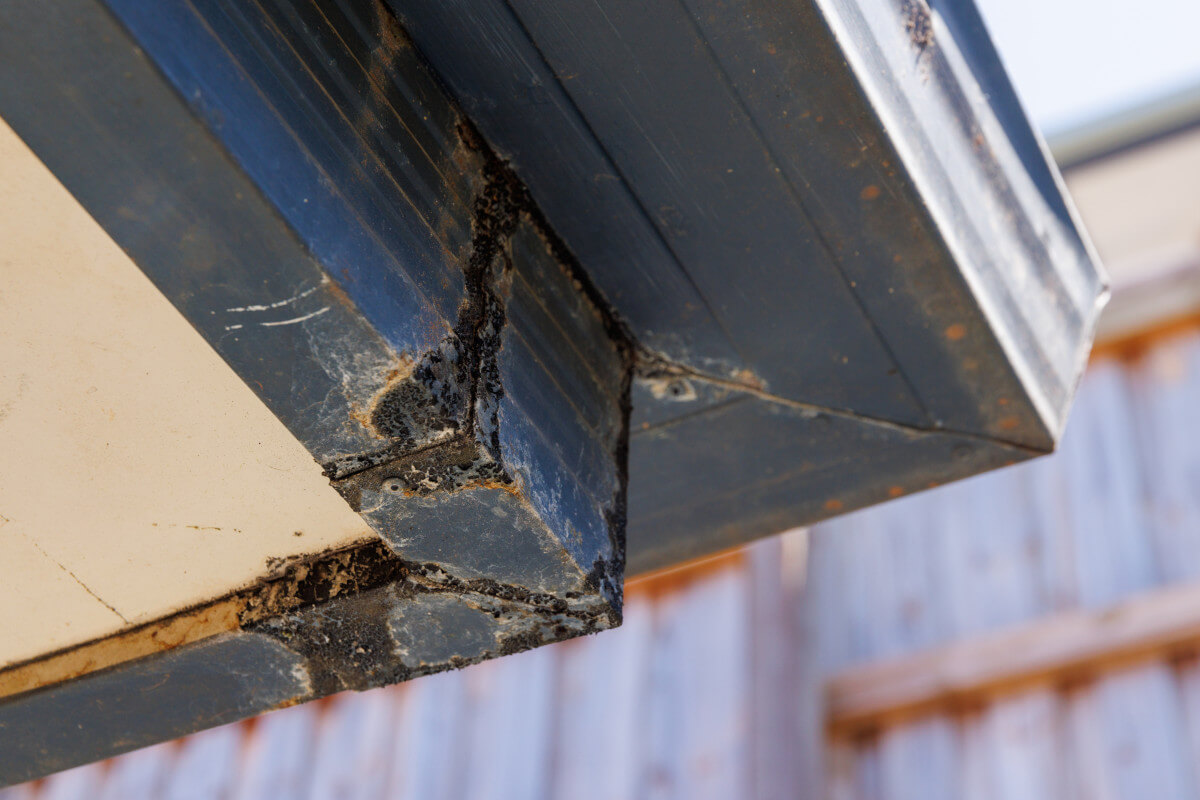
Gutter problems almost never start as obvious problems. They start as a small drip at one corner, a hairline crack in a sealed seam, a slightly loose hanger that lets water pool an extra inch deep. By the time something is dramatic enough that you can’t ignore it from the driveway, it’s usually been going on for a while.
This guide walks through what to look for, in plain language, so you can catch issues early — or figure out whether what you’re seeing is actually a problem at all. It’s written from what we see most often across Cobb, Cherokee, North Fulton, and Paulding counties.
Signs You Can Spot From The Ground
Most of the early warning signs are visible from your driveway or yard during good light. You don’t need a ladder to do a useful inspection — in fact, you shouldn’t be on a ladder for this. Just walk the perimeter slowly and look up.
- Visible debris hanging over the edges. If you can see leaves, pine needles, or sweet gum balls peeking over the lip of the gutter from the ground, the gutter is already overfull. In pine-heavy parts of Cherokee or Paulding, this can happen any time of year. In hardwood neighborhoods around East Cobb and Roswell, the worst of it is October through November.
- A gutter that’s visibly sagging in the middle of a run. A gutter should be roughly straight or pitched gently toward the downspout. A sag means a hanger has failed or the fascia behind it has softened.
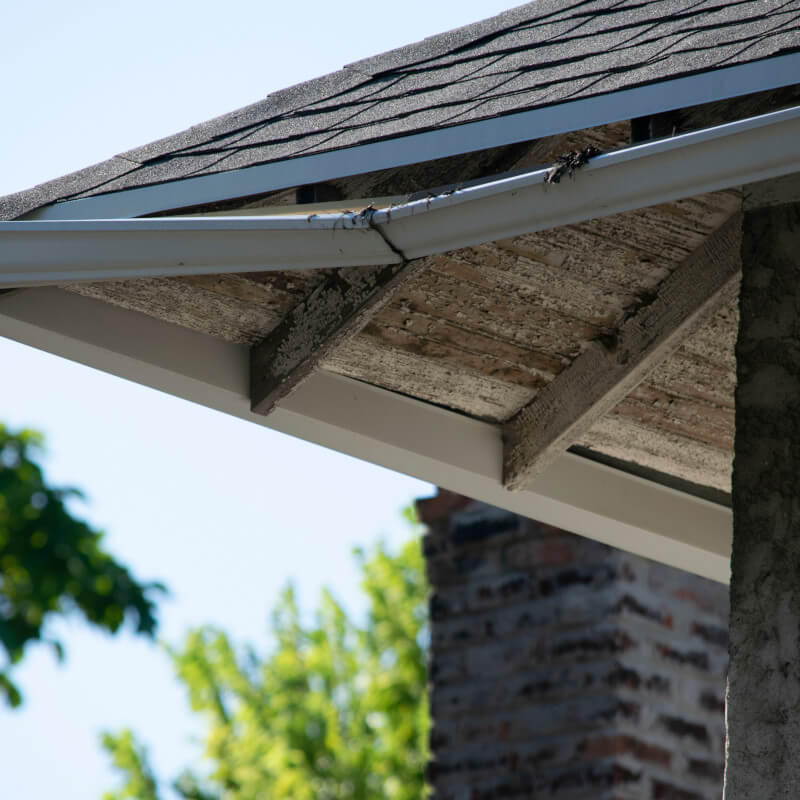
- A gutter pulling away from the house with a gap between the back of the gutter and the fascia. Daylight visible behind a gutter means water can — and does — track straight down the fascia board.
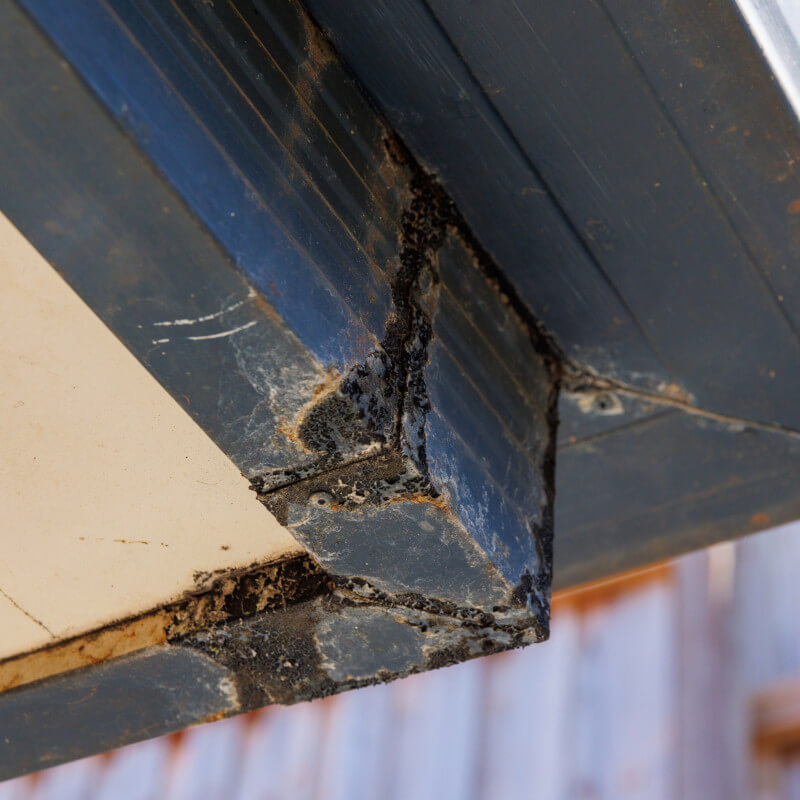
- Streaks of staining on siding below a corner, an end cap, or a downspout joint. Vertical dark streaks usually mean a slow leak that’s been running for a while.
- Peeling paint on the fascia directly behind or below a gutter. The wood is being kept wet long enough for the paint to fail.
- Rust streaks on aluminum gutters (from fasteners) or rust-through on older galvanized steel gutters (still in service on some original mid-century homes in Marietta and East Cobb).
- Downspouts that have separated at a joint or detached from the wall.
Call 770-369-3743 or use our Contact Form for a FREE QUOTE!
Signs That Show Up During Rain
The most useful time to evaluate a gutter system is when it’s actually doing its job. If you’re home during one of Metro Atlanta’s summer thunderstorms, take a minute to watch the system work.
- Water sheeting over the front edge of the gutter instead of moving through it. This usually means a clog, but it can also mean the gutter is undersized for the roof area or pitched wrong.
- Water shooting out the top of the gutter above a downspout. The system is backing up because the downspout can’t accept water fast enough — usually a clog at the downspout outlet or elbow.
- A waterfall coming out of a middle section of a downspout rather than the bottom. The downspout has separated at a slip joint.
- Drips coming straight down from a seam, miter, or end cap during light rain (when water shouldn’t be reaching those points yet).
- Water pouring out behind the gutter rather than off the front. This points to an apron flashing problem or a back-of-gutter leak — both worth addressing before the fascia gives way.
- Downspouts not flowing when everything else is running. They’re clogged.
Signs At The Foundation And In The Yard
Even if the gutters look fine, what happens below them tells you whether the system is actually working. Walk the property after rain has stopped:
- Erosion channels or rills cut into mulch, sod, or beds directly below a downspout
- Standing water at the foundation that doesn’t drain within a few hours (Metro Atlanta’s red clay holds moisture longer than other soils, so a little standing water isn’t unusual — but it shouldn’t be persistent)
- Mulch washed onto a walkway or driveway from a discharge point
- Exposed roots, sediment trails, or bare soil patches in beds adjacent to downspouts
- Soggy ground that’s noticeably wetter on one side of the house than the others
- Settling or cracking in walkways, patio sections, or driveway joints adjacent to a downspout
- A buried downspout tie-in that gurgles or backs up during heavy rain, indicating a collapsed or root-blocked line
Call 770-369-3743 or use our Contact Form for a FREE QUOTE!
Signs Inside The House
Interior symptoms mean the problem has been going on for a while and water has already found its way in. Don’t ignore these.
- Stains on upstairs ceilings near an exterior wall, especially in the corner of a room
- Water tracking down the inside of an exterior wall — sometimes visible as bubbling paint, sometimes as a damp spot you can feel with your hand
- Stains around the trim of an upstairs window on an exterior wall, particularly at the header
- Water in the basement or crawlspace after rain, especially on the side of the house where downspouts discharge
- A musty smell in the basement or crawlspace that gets worse after storms
- Efflorescence (the chalky white powder) on basement or foundation walls
- Damp insulation in the attic near the eaves, indicating water back-tracking under the roof edge
Signs At The Eave And Soffit
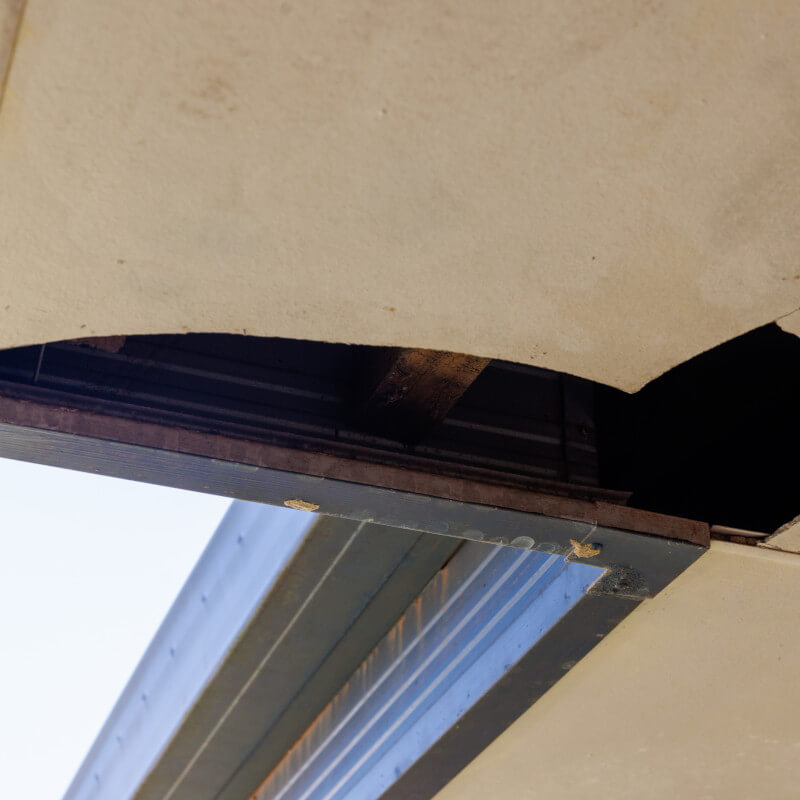
The eave (where the roof meets the wall) and the soffit (the underside of the overhang) are where gutter problems often show their consequences first. Looking up from underneath the overhang:
- Discoloration or staining on the soffit, especially near where it meets the fascia
- Sagging or warped soffit panels
- Visible rot, soft spots, or holes in the fascia behind the gutter
- Open hanger holes where a previous hanger pulled out and was never replaced
- Wasps, bees, or birds working into gaps where soffit panels have failed
- Wood-frass (sawdust-like material) on the ground below the gutter, indicating insects in compromised wood
Seasonal Signs To Watch For In Metro Atlanta
Gutter problems tend to surface on a predictable calendar in this part of Georgia.
Spring (March-May): Pollen, oak tassels, and seed pods drop in volume and clog gutters that came through winter fine. Spring thunderstorms then expose any clogs, weakened seams, or hangers that took freeze-thaw damage over winter. This is when emergency calls for wind and limb damage spike.
Summer (June-September): Heavy thunderstorm rainfall — sometimes hitting peak rates near 7 inches per hour — stresses every weak point in the system at once. Year-round pine straw continues to clog gutters and downspouts. Most “the gutter just couldn’t keep up” calls happen in summer.
Fall (October-November): Hardwood drop in older neighborhoods (oak, maple, sweet gum, hickory) is the biggest annual debris load. Sweet gum balls in particular jam downspouts in East Cobb, Marietta, and the older parts of Roswell and Alpharetta.
Winter (December-February): Mostly quiet, but the rare hard freeze can split seams, stress hangers, and push water into soffits when ice builds up in a partially clogged gutter. Late winter is the right time to schedule a cleaning and inspection before spring storms arrive.
Call 770-369-3743 or use our Contact Form for a FREE QUOTE!
How Urgent Is What You’re Seeing?
Here’s a rough triage of what we see most often:
Schedule it soon, but not urgent: Debris over the gutter edge, a few drips at miters during heavy rain, mild staining on siding, mulch washout below a downspout, a gutter that needs cleaning. These are problems, but they aren’t actively damaging the house yet.
Schedule it this week: Visible sagging, daylight between gutter and fascia, water spilling out behind the gutter, separated downspouts, soft spots in fascia, persistent standing water at the foundation. These are doing real damage that gets meaningfully worse with each storm.
Call now: Active water intrusion into the house, a gutter that’s come off or is about to, fascia or soffit failure visible from the ground, storm damage with more weather in the forecast, basement water during rain. These are emergency gutter repair situations.
What To Do Next
If you’ve gone through this checklist and spotted anything in the “schedule it this week” or “call now” categories, the right next step is usually a free inspection.
We come out, look at the whole system, tell you what we see, and quote what it’ll cost to fix.
If you’re only seeing items in the “schedule it soon” category, you may just need a cleaning and a tune-up rather than a full repair.
We’ll be honest about that — if the right fix is a cleaning, we’ll tell you that and quote a cleaning, not a repair you don’t need.
Why We Wrote This Guide
Sebastian Martinez founded The Life Home Services after more than 20 years in the gutter industry. One of the things he learned over those decades is that homeowners are usually the best people to spot gutter problems early — they know what their house normally looks like, and they notice when something is off. The hard part is knowing which “off” things matter and which don’t. This guide is meant to make that easier.
Schedule A Free Inspection
If you’ve spotted warning signs and want a professional set of eyes on the system, call The Life Home Services at 770-369-3743 or reach out through our contact form. Every estimate is free, in writing, and explained before any work begins.
You can also read more about our full gutter repair services, our gutter cleaning work if the problem is just debris buildup, or specific repair types like gutter leak repair, downspout repair, drainage repair, or fascia and soffit repair.
Call 770-369-3743 or use our Contact Form for a FREE QUOTE!