This post is the regional explainer we’ve been wanting to write for a long time. If you live anywhere from Powder Springs to Ball Ground, from Smyrna to Alpharetta, here’s why your gutters work harder than national averages assume — and what that means for how often you should be paying attention to them.
The pine problem
You can see it from any flight into Hartsfield-Jackson on a clear day. North of the city, the canopy gets noticeably greener and shaggier as you cross from downtown into Cobb, Cherokee, North Fulton, and Paulding. That’s pine — millions of trees of it, spread across every neighborhood older than about fifteen years.
Loblolly pine is the dominant species across most metro Atlanta neighborhoods, joined by shortleaf and Virginia pine in the northern suburbs and white pine as an ornamental in older established subdivisions. Each species drops needles continuously throughout the year, with a heavy peak in late fall. Unlike deciduous leaves, which mostly fall in a concentrated 4–6 week window, pine needles drop year-round. There’s no “off-season” for pine debris.
A pine needle is also, mechanically, the worst possible debris for a gutter system. It’s 3 to 6 inches long but very thin — under a millimeter in diameter at its widest point. That combination means pine needles weave themselves into mats inside gutters that water can’t easily push through. They also pass through nearly every kind of gutter guard — screens, perforated panels, foam, brush. Only fine micro mesh stops them reliably, which is one of several reasons we end up installing a lot of micro mesh in metro Atlanta.
This is the first reason national cleaning frequency advice doesn’t fit. The “twice a year” standard assumes deciduous-dominant tree cover with a defined seasonal drop. Most metro Atlanta neighborhoods don’t match that picture.
The hardwood problem on top of the pine problem
Many older neighborhoods in Cobb County, East Cobb, the inside-the-perimeter parts of Sandy Springs, and the established subdivisions of Marietta and Roswell have substantial mature hardwood cover layered over the pine — oaks, maples, sweet gums, hickories. These are the trees that built the south’s regional character, and they’re stunning. They also produce a debris load very different from pine.
Oak leaves are wide, leathery, and slow to decompose. They mat together when wet, sit on top of pine needles, and create heavy layers in gutter sections that won’t move with rain alone. Sweet gum trees drop their distinctive spiked gum balls in fall, which are mechanically perfect for clogging downspouts — slightly larger than the opening, weighted enough to drop in and lodge. Maple helicopters land in spring and seed-pod themselves into every available crack.
The combination — a year-round pine needle drop, plus a heavy seasonal hardwood drop layered on top, plus the spring pollen and seed-pod load — produces a debris cycle that essentially never stops. Some weeks are worse than others, but there isn’t a true quiet season for most metro Atlanta gutters.
Call 770-369-3743 or use our Contact Form for a FREE QUOTE!
Then the rain hits
The third factor is what happens when the debris meets a metro Atlanta thunderstorm.
Atlanta sits in one of the most thunderstorm-active parts of the country, with peak rainfall rates that hit 7 inches per hour during the heaviest summer storms. To put that in perspective — Phoenix’s annual rainfall is roughly 8 inches. Atlanta can drop that much in a single afternoon during the right conditions.
When a heavy storm hits a gutter system that’s even modestly compromised by debris, three things happen in sequence:
First, the debris that was sitting in the gutter forms a dam against the downspout opening. Water that should be flowing toward the downspout instead pools behind the debris and rises in the gutter.
Second, the rising water finds the lowest point in the gutter — usually a sag, a seam, or the front edge. The volume that’s supposed to be moving down the downspout instead pours over the front edge in a sheet, hits the ground at high velocity, and creates the foundation-soaking, fascia-streaking damage pattern we see on roughly half the homes we visit.
Third, the volume of water moving through any debris that does pass into the downspout creates a hydraulic pressure that pushes accumulated material deeper into the system — into underground drain tie-ins, against drainage discharge points, into places that are dramatically harder to clean than the gutter itself.
This sequence happens during a 20-minute thunderstorm. It happens every time a heavy storm hits a compromised system. And it’s why metro Atlanta gutter damage tends to be sudden — a homeowner who’s been ignoring their gutters for two years discovers the problem in a single storm event, often catastrophically.
What this means for cleaning frequency
The “twice a year” national recommendation comes from regions with moderate tree cover, predictable seasonal drops, and steady spring/fall rainfall. Almost none of those conditions apply to metro Atlanta.
What we actually recommend for north Atlanta homes, by tree cover type:
Minimal tree cover (open lot, no overhanging branches): Once a year is genuinely enough, ideally in late November after the deciduous drop is mostly complete.
Moderate tree cover (some overhanging hardwoods, mixed neighborhood): Twice a year — late spring after pollen and seed-pod accumulation, late fall after the leaf drop.
Heavy hardwood cover (mature oak/maple/sweet gum overhead): Twice a year minimum, plus an inspection after any major storm event.
Pine-heavy properties: Three to four times a year without gutter guards. There is no realistic schedule that keeps pine-heavy gutters clean for long with traditional cleaning alone — which is why pine-heavy properties benefit so much from gutter guards over the long term.
For more on what professional gutter cleaning actually involves and what it costs across metro Atlanta — by single vs two-story, debris load, and county-by-county variation — see our gutter cleaning and gutter cleaning cost pages.
Call 770-369-3743 or use our Contact Form for a FREE QUOTE!
What this means for cleaning quality
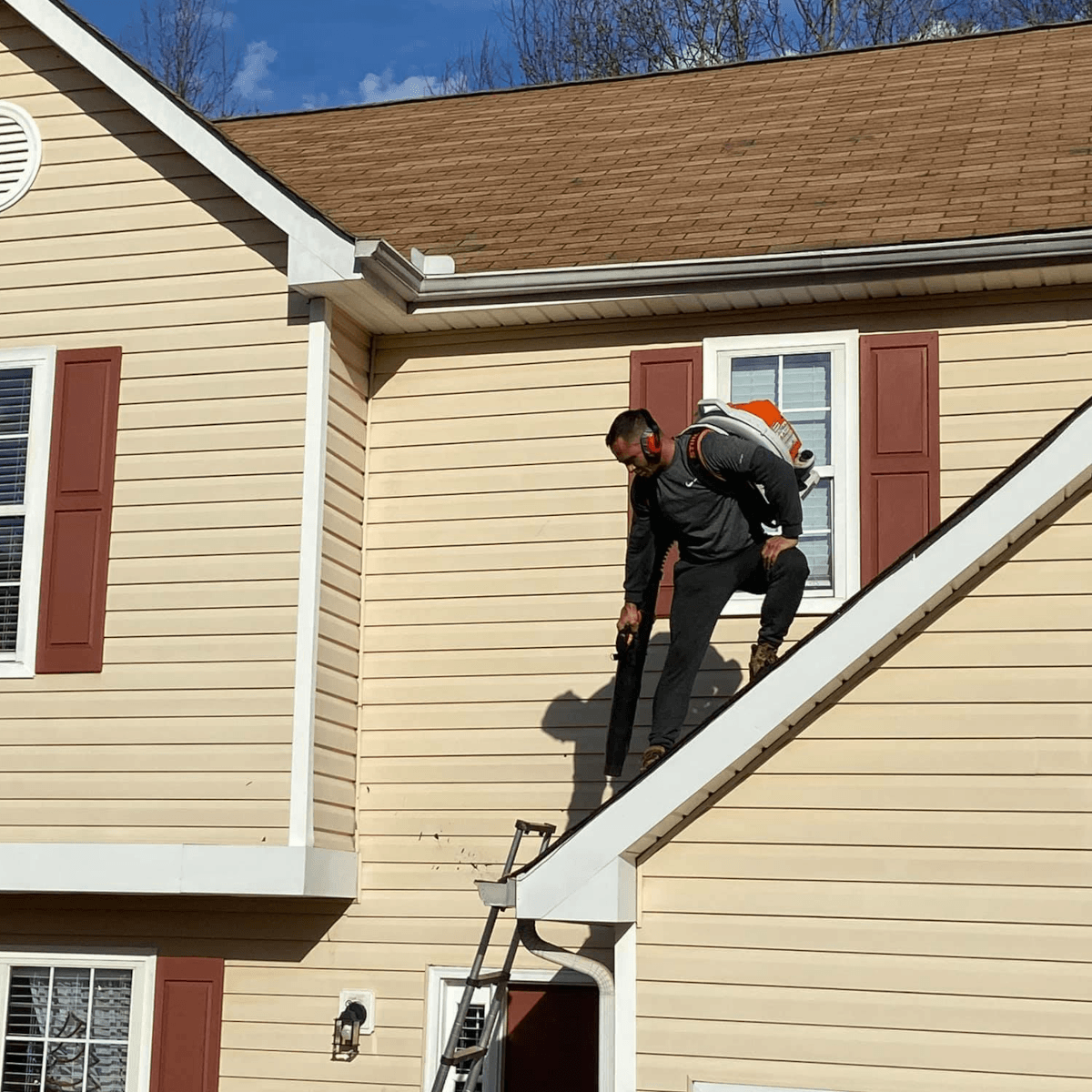
The national $99 leaf-blower model — pull up, blow debris out of the gutters and off the roof, leave — was designed for low-debris regions where that approach mostly works. In metro Atlanta, it doesn’t.
The reason: pine needles that are blown out of a gutter don’t blow far. They land on the next roof section, on the landscaping below, or in the gutters on the next elevation. Hardwood leaves that are blown off the roof get picked up by the wind from the next storm and deposited right back where they came from. Sweet gum balls that are blown out of a gutter often roll back into the downspout opening on their way down.
The 25-minute leaf-blower job that’s perfectly adequate in low-debris regions is not actually a cleaning in north Atlanta. It’s a temporary visual fix that fails completely within one to two storm events. The cleaning that works here is hand removal, downspout flushing, and full debris haul-away — the work that takes 1.5–3 hours per home and that we’ve structured our entire service around.
This is why our pricing looks different from the $99 ads you see in mailers. We’re doing genuinely different work, on a system that needs more attention than national averages assume.
What this means for gutter sizing
There’s one more way north Atlanta is different — the gutters most homeowners have are too small for the actual rainfall rates.
Standard 5-inch K-style gutters with 2×3 downspouts are the residential default across most of the country. They’re sized for moderate roof loads in moderate-rainfall regions. In metro Atlanta, that sizing is genuinely undersized for steep roofs, large footprints, or homes with significant tree exposure (where downspout openings are partially obstructed by debris even in a “clean” state).
We frequently recommend 6-inch K-style with 3×4 downspouts for north Atlanta homes that are being replaced or newly installed — particularly on two-story homes, steep-pitched roofs, or properties with mature tree cover. The 6-inch system moves roughly 40% more water per minute than a 5-inch, which matters specifically in the storm conditions metro Atlanta sees regularly.
If your existing gutters overflow during heavy rain even when they appear clean, sizing is likely the underlying problem. Cleaning more often won’t fix it.
What this means for the bigger picture
The combination of pine, hardwood, peak storm intensity, and undersized gutters means metro Atlanta homes need:
More frequent cleaning than national averages suggest. Higher-quality cleaning than the $99-special standard. Gutter sizing matched to actual storm conditions. Real consideration of gutter guards for any home with significant tree cover, because the cleaning cost curve over time tilts strongly toward guards in our region.
The good news: with the right system properly maintained, metro Atlanta gutters work fine. There’s nothing inherent about the climate that makes water management an unsolvable problem. The bad news: the “good enough” national approaches don’t quite work here, and homeowners who assume they will end up with the cascading damage pattern that 4+ years of skipped or inadequate cleaning produces.
If you’d like to talk through what your specific home actually needs — based on its location, age, tree cover, and current gutter condition — we’d be glad to come out for a free estimate. We’ve cleaned, repaired, replaced, and installed gutters across Woodstock, Marietta, East Cobb, Roswell, Alpharetta, Milton, Sandy Springs, Kennesaw, Acworth, Smyrna, Canton, Holly Springs, Hickory Flat, Ball Ground, Dallas, and Powder Springs. We know what works in this specific region because we work in it every day.
Call 770-369-3743 or use our Contact Form for a FREE QUOTE!