
Here’s what actually changes when you cross that county line — the tree cover, the topography, the storms, and what your gutters need as a result.
Cobb County: The mature hardwood story
Cobb is older. The housing stock includes substantial inventory from the 1960s, ’70s, and ’80s, particularly in East Cobb, established Marietta neighborhoods, and the inside-the-loop portions of Smyrna. With that age comes mature hardwood canopy — the oaks, maples, sweet gums, and hickories that have been growing in these neighborhoods for 40 to 70 years.
The debris pattern in mature Cobb neighborhoods is dominated by:
Hardwood leaf drop in fall. Heavy, leathery oak and maple leaves that mat together when wet and create thick layers in gutter sections. The peak drop is mid-October through mid-November in most Cobb neighborhoods, with a long tail running into December.
Sweet gum balls in fall. The spiked seed pods from sweet gum trees are mechanically perfect for clogging downspouts. We pull them out of downspout openings every fall in East Cobb specifically — sweet gums are heavily represented in that area.
Spring helicopters and seed pods. Maples drop their winged samaras (helicopter seeds) in spring along with massive pollen loads. These accumulate in gutters faster than people expect.
Acorns and hickory nuts. Less of a gutter problem and more of a “things rolling on your roof at night” problem, but they end up in gutters too.
The Cobb pattern is heavy seasonal debris with relatively predictable timing. You can plan a cleaning schedule around it — late spring after the helicopters drop, late fall after the leaves come down, and you’re mostly in good shape.
Call 770-369-3743 or use our Contact Form for a FREE QUOTE!
Cherokee County: The pine story
Cherokee is younger as a developed county. While there’s older inventory in Canton proper and some of the original Woodstock neighborhoods, much of the residential growth happened in the 1990s, 2000s, and 2010s — and a lot of that growth happened in formerly forested areas where pine was the dominant species before development.
The result is that most Cherokee neighborhoods have substantial pine cover, often as the dominant tree type. Loblolly pine particularly, with shortleaf and Virginia pine in some areas.
The debris pattern in Cherokee is dominated by:
Continuous pine needle drop. This is the biggest single difference between the counties. Pine needles don’t have a seasonal drop — they fall year-round, with a heavier peak in late fall but never a quiet period. A Cherokee gutter that gets cleaned in May is dirty again by August.
Pine cones in fall. Less common than needles, but they appear in gutters and downspouts during heavy drops. Smaller than sweet gum balls but more shaped to wedge into corners.
Mixed hardwood in older Cherokee neighborhoods. Original Canton and old Woodstock have hardwood layered onto the pine. These properties get the worst of both worlds.
Bird and squirrel nesting material. Pine straw makes excellent nesting material, and pine-heavy properties see more wildlife traffic in the gutter system.
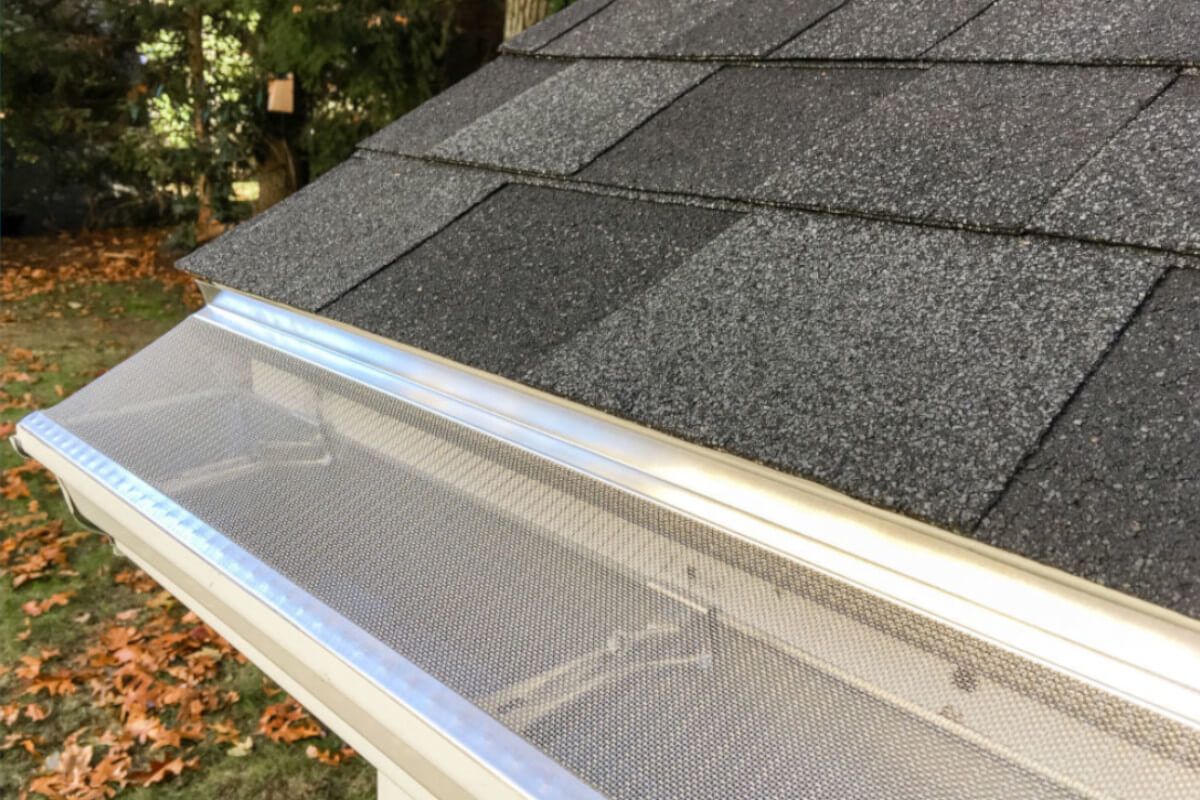
The Cherokee pattern is lighter peaks but year-round debris. You can’t really clean Cherokee gutters into a “done” state for long — there will be new pine straw within a few weeks. This is why we recommend Cherokee homes either commit to more frequent cleanings or invest in micro mesh gutter guards, which are the only guard type that reliably stops pine needles.
Call 770-369-3743 or use our Contact Form for a FREE QUOTE!
Topography differences
Beyond tree cover, the two counties have subtle topography differences that affect gutter performance:
Cobb is flatter on average. Particularly southern and central Cobb (Smyrna, central Marietta, Powder Springs). Flatter lots mean roof runoff has to travel farther horizontally to find a discharge point, which means longer underground drainage tie-ins and more opportunity for downspouts to back up if drainage gets compromised. We see more underground drainage issues in southern Cobb than anywhere else in our service area.
Cherokee is more topographically varied. The northern parts of Woodstock, Canton, and Ball Ground get into the foothills of the Blue Ridge. Steeper lots, more sloped properties, and homes with walkout basements that effectively put rear-elevation gutters at three-story height. Two-story gutter work in northern Cherokee is often more two-and-a-half-story or three-story in practice.
East Cobb has the most established underground drainage infrastructure. Many homes have buried tie-ins running 30–60 feet to a daylight point or a buried catch basin. When these clog, they’re significantly harder and more expensive to clear than surface drainage.
Newer Cherokee subdivisions often have minimal drainage infrastructure. Many newer homes simply discharge directly onto the lawn with a splash block. This works fine for moderate rain but compounds problems during heavy storms when discharge volumes exceed what the surrounding ground can absorb.
What this means for cleaning frequency
The right cleaning schedule looks different in each county:
Cobb County, moderate-to-heavy hardwood cover: Mid-to-late May (after spring drop), mid-to-late November (after leaf drop is mostly complete), optional post-storm inspection. Total: 2 cleanings per year is sufficient for most homes.
Cherokee County, pine-dominant cover: Late April / early May (post-winter cleanup plus first pine accumulation), mid-July (mid-year pine catch-up), mid-to-late November (full fall cleanup). Total: 3 cleanings per year minimum; 4 for heavily-pine properties.
Either county, mature mixed cover (rare but does happen): Treat as Cherokee — 3+ cleanings per year because the pine drives the schedule.
For more on what professional gutter cleaning actually involves and current metro Atlanta pricing, see our gutter cleaning and gutter cleaning cost pages.
Call 770-369-3743 or use our Contact Form for a FREE QUOTE!
What this means for gutter guards
The cost-benefit calculation tilts differently in each county:
For Cobb homes with mature hardwood cover: Guards make sense but the breakeven is moderate — typically 3–5 years on single-story, 2–4 years on two-story. Hardwood debris is heavy but seasonal, so the cleaning bill is significant but not relentless. Some Cobb homeowners genuinely prefer the rhythm of two annual cleanings and don’t see enough upside in guards to make the change.
For Cherokee homes with pine cover: Guards make sense for nearly every home with meaningful pine. The breakeven is fast — typically 2–3 years on single-story, often under 2 years on two-story. The “we’ll just keep cleaning more often” approach almost never pencils out because the cleaning frequency required to actually stay ahead of pine debris is high enough that the annual cost approaches or exceeds the guard install cost within a few years.
If you’re researching guards specifically because of pine straw problems, our pine needle gutter guards page is the deeper resource on this.
A quick note on Paulding County (Dallas area)
If you’re in Dallas or Hiram (Paulding County, immediately west of Cobb), you’re getting a mix of both patterns. Newer subdivisions in Paulding lean toward the Cherokee pine pattern; older properties closer to the Cobb line lean Cobb-style. We treat each Paulding home individually rather than applying a county-wide pattern.
A quick note on north Fulton (Roswell, Alpharetta, Milton, Sandy Springs)
North Fulton is its own animal — older established neighborhoods with extensive mature hardwood (much heavier than typical Cobb), often without significant pine, plus larger average home sizes and more complex rooflines. We’ll write that story separately. For now: North Fulton sits closer to the Cobb pattern but with even heavier seasonal hardwood loads.
What to do with this information
If you’re in either county and trying to figure out your gutter situation, the honest first step is just an estimate. We come out, look at your actual home and tree cover, evaluate the existing gutters, and give you a written quote — including an honest recommendation about whether you should be on a 2x, 3x, or 4x annual schedule, whether guards make sense for your situation, and whether the existing system needs anything beyond cleaning.
No pressure, no upsell, no aggressive sales tactics. Just a contractor who works both counties every week giving you a real assessment.
Call 770-369-3743 or use our Contact Form for a FREE QUOTE!