


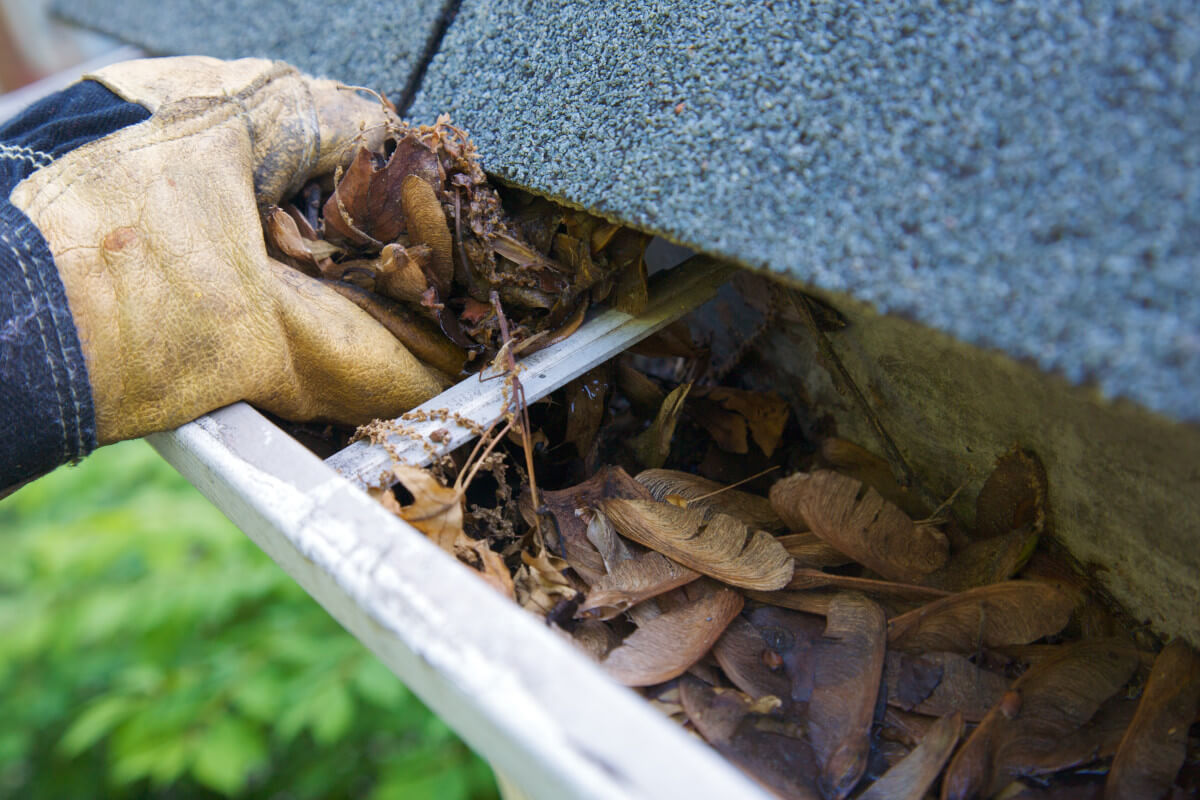
If your gutters are spilling water during rain, holding standing water between storms, or sending water down the side of the house instead of through the downspout, you have a clog. In Metro Atlanta, clogs usually develop fast: a single heavy summer thunderstorm can flush enough pine straw and shingle grit into a half-full gutter to block it the rest of the season. Once it’s blocked, every storm makes the damage worse.
Call 770-369-3743 or use our Contact Form for a FREE QUOTE!
The Life Home Services clears clogged gutters across Cobb, Cherokee, north Fulton, and Paulding counties. Owner Sebastian Martinez has 20+ years in the gutter industry. If your gutters are actively overflowing right now, call 770-369-3743 — we’ll schedule you as soon as possible.
How To Tell What Kind Of Clog You Have
Not every clog is the same. Knowing which type you’re dealing with helps you understand the urgency and what the fix actually involves.
Surface Clogs (Visible Debris In The Gutter)
If you can see leaves, pine straw, or sweet gum balls sitting in the gutter from the ground, that’s a surface clog. The gutter is full of debris, water can’t move through it freely, and it overflows the front edge during rain.
This is the most common type of clog and also the simplest to clear — the debris has to be physically scooped out, run by run.
Downspout Clogs (Water Backing Up The Run)
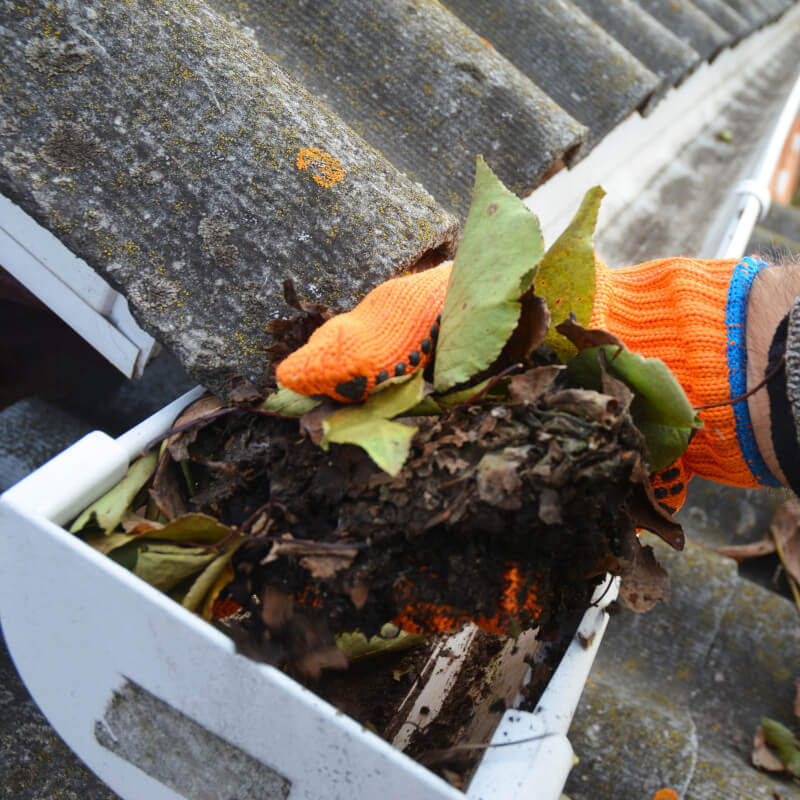
A downspout clog is usually invisible from the ground. The gutter itself may look mostly clean, but water still spills over because the downspout opening is blocked. The most common culprits in Metro Atlanta are sweet gum balls, which wedge into the 2×3 or 3×4 downspout opening at the top of the run, and matted pine straw that compacts into the same spot. You’ll often see the water spilling over closest to the downspout rather than evenly across the run.
If the downspout opening is clear but water still backs up partway down the line, the clog is inside the downspout itself, usually at an elbow. See our downspout repair page for how that’s addressed.
Hidden Clogs (Underground Drain Line)
If your downspouts feed into a buried PVC line that carries water away from the house, the clog may not be in the gutter at all — it may be in the underground line. When that line clogs, water backs up the downspout and then over the gutter even though the gutter itself is clean. You can usually identify this by looking at the downspout discharge: if it’s not flowing during rain, and the gutter and downspout look clear, the buried line is the suspect. See our underground gutter drain cleaning page for what that involves.
Pitch And Sag Problems Disguised As Clogs
Sometimes the gutter isn’t really clogged — it’s pitched wrong, sagging, or sitting too low at one end. Standing water collects and looks like a blockage, but the underlying problem is that the gutter isn’t draining toward the downspout the way it should. A cleaning won’t fix this. See gutter drainage repair for what the actual repair looks like.
Call 770-369-3743 or use our Contact Form for a FREE QUOTE!
Why Clearing A Clog Yourself Usually Goes Wrong
Most homeowners eventually try to clear a clog themselves. A few common ways it doesn’t work out:
- The leaf-blower trick. Pointing a leaf blower into the gutter from a ladder works on light, dry leaves and almost nothing else. Wet pine straw, sweet gum balls, and clay sediment don’t move with air. You’ll spend an hour on a ladder, scatter a small amount of debris over your yard, and leave the actual blockage in place.
- Hose flushing without scooping first. Running a hose into a packed gutter just turns dry debris into a heavy, soaked mat that’s harder to remove. If the gutter is already clogged, water doesn’t have anywhere to go.
- Snaking the downspout from the bottom. People try to push debris up and out from the discharge end. It usually packs the clog tighter rather than freeing it.
- Reaching too far on a ladder. Most ladder falls happen because someone shifted weight sideways to reach an extra two feet of gutter. Clogged gutters tend to be on two-story sides of the house, where the consequences are worse. See two-story gutter cleaning for what taller cleaning involves.
- Quitting halfway. The most common outcome — the homeowner clears the visible debris from the front edge, doesn’t actually flush the downspouts, and the gutter overflows again at the next storm because the underlying blockage is still in place.
What’s Included In Our Clogged Gutter Service
Clearing a clog properly means treating the gutter system as a whole, not just removing what’s visible:
- Hand-scoop all debris from every gutter run — not just the visibly blocked sections. Adjacent runs are usually loaded even if they’re not actively overflowing yet.
- Clear every downspout opening of sweet gum balls, matted pine straw, twigs, and shingle grit.
- Flush every run end-to-end and confirm water actually exits at the discharge — either at the splash block or at the underground drain inlet.
- Test each downspout with running water to confirm it runs freely. Slow downspouts mean a clog further down the line.
- Bag and remove all debris from the property — nothing left on your lawn or in your beds.
- Free written roof and gutter inspection. We document anything we find, with photos. See free roof and gutter inspection.
If we find a clog that turns out to be inside an underground drain line or a damaged downspout, we tell you what we found and what fixing it would involve, with a written estimate. No surprise add-ons.
Clogged Gutter Cleaning Cost
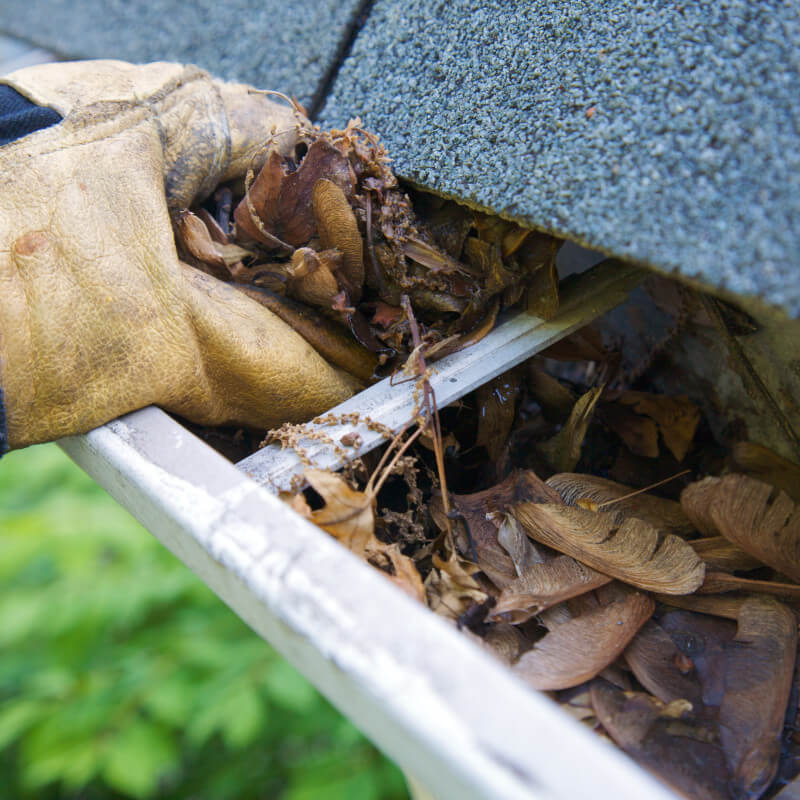
Clogged gutters cost more to clean than a routine maintenance visit because they take longer and require more work. We publish our pricing rather than asking you to call for a quote on a problem we haven’t looked at yet:
- Single-story homes: $175 to $300 for the cleaning, plus the clog add-on.
- Two-story homes: $300 to $550 for the cleaning, plus the clog add-on.
- Heavy clog add-on: $75 to $200, depending on how impacted the gutters are.
- Underground drain clearing: quoted separately if the buried line is the issue. See underground gutter drain cleaning for that service.
Final pricing is always confirmed in your free written estimate before any work starts. For more on what affects cleaning cost generally, see gutter cleaning cost.
Call 770-369-3743 or use our Contact Form for a FREE QUOTE!
When A Clog Is Actually A Repair Issue
Sometimes a “clogged” gutter is really a damaged one. A few signs that a cleaning alone won’t solve the problem:
- The gutter overflows in the same spot every storm, even right after a cleaning. The gutter is probably pitched wrong or sagging in that section.
- A whole section of gutter has visibly pulled away from the fascia. Hangers have failed.
- Water dumps from a seam or end cap instead of from the top edge. The seal has failed. See gutter leak repair.
- You see water inside a wall or hear it during rain. That’s urgent — see emergency gutter repair.
Most of these can be diagnosed during the cleaning visit, with a written repair estimate handed to you the same day. See our gutter cleaning and repair page for how combined visits work.
Don’t Wait For The Next Storm
Clogged gutters get more expensive the longer they stay clogged. Every storm pushes water into places it shouldn’t go — behind the fascia, down the siding, against the foundation, into the soffit. A clog that costs $250 to clear in June can lead to a $2,500 fascia repair by next spring.
Once the gutters are clear, the easiest way to keep them that way is either a gutter maintenance program or micro-mesh gutter guards. The maintenance program keeps clogs from forming; guards reduce how often you need anyone on a ladder in the first place. We’ll talk through which makes sense for your house during the visit.
Where We Serve
- Cobb County: Marietta, East Cobb, Smyrna, Kennesaw, Acworth, Powder Springs.
- Cherokee County: Woodstock, Canton, Holly Springs, Hickory Flat, Ball Ground.
- North Fulton: Roswell, Alpharetta, Milton, Sandy Springs.
- Paulding County: Dallas and Hiram.
Schedule Clogged Gutter Cleaning
Call 770-369-3743 or use our contact form for a free written estimate. If your gutters are actively overflowing, let us know on the phone — we’ll work to schedule you as soon as possible, especially during the summer thunderstorm and fall hardwood-drop seasons when this is most urgent.
Call 770-369-3743 or use our Contact Form for a FREE QUOTE!